Looking for an honest HubSpot CRM review before you move your contacts and deals into it? The short answer: HubSpot’s free CRM is still one of the easiest ways to get a real contact database, deal pipeline, and email tracking running in an afternoon, but the free plan is much tighter than it used to be. It now covers up to 2 users and 1,000 contacts, and paid Starter seats list at $20/mo, with a new-customer offer of $7/mo per seat on annual billing.
In this review I’ll cover what HubSpot CRM does, how the free and paid tiers really differ, what each plan costs in 2026, and who should (and shouldn’t) build their sales process on it. All prices below were checked on HubSpot’s own pricing pages on 2 Nov 2026.
What is HubSpot CRM?
HubSpot CRM (HubSpot calls it the “Smart CRM”) is the shared customer database that sits under every HubSpot product. Contacts, companies, deals, and tickets live in one place, and the Marketing, Sales, Service, Content, Data, and Revenue hubs all read from and write to those same records.
That is the main reason people pick HubSpot: when a lead fills in a form, opens an email, chats on your site, and later books a sales call, all of that activity lands on one contact timeline that the whole team can see. You can start on HubSpot’s free tools without a credit card and add paid hubs only when you outgrow the limits.
HubSpot CRM Features Worth Knowing
Contact and company records
Every contact gets a timeline of emails, calls, meetings, notes, form fills, and chats. The free account allows 1,000 contacts and 1,000 records across the other standard objects (companies, deals, tickets), so it suits a small or early-stage team rather than a large imported list.
Deal pipeline and reporting
Deals move through stages on a board view, and the free plan includes 10 reporting dashboards with up to 50 reports each. Starter raises this to 30 dashboards and allows up to 15 pipelines per account across object types.
Email, meetings, and live chat
Free users get 1-to-1 email logging, a personal meetings link, live chat, and simple conversational bots, all with HubSpot branding. Marketing email is capped at 2,000 sends per calendar month on the free plan, with only 3 email templates per account. Starter removes branding, lifts the template limit, and allows email sends of 5x your marketing contact tier.
Forms, landing pages, and ads
You can build forms and up to 30 landing pages on the free plan, and connect ad accounts to see which campaigns produce contacts. Starter adds simple ad automation and contact-list audiences.
Starter extras: calling, automation, and AI
Paid Starter seats add 500 calling minutes, a HubSpot-provided phone number (not available in every country), up to 50 simple sales workflows, payments, e-signatures, multi-currency support, and 500 HubSpot Credits for AI agents and features. Extra credits cost $0.010 each.
Integrations and mobile app
HubSpot has an App Marketplace for connecting other tools, plus iOS and Android apps for checking records and logging activity on the go.
HubSpot CRM Pricing 2026
HubSpot sells the CRM free, then charges per seat for each hub. The table shows Sales Hub, the most common upgrade for a CRM buyer. Starter prices are the same for the Marketing and Service Starter tiers, and one Starter seat bundles Marketing, Sales, Service, Content, and Data Hub Starter.
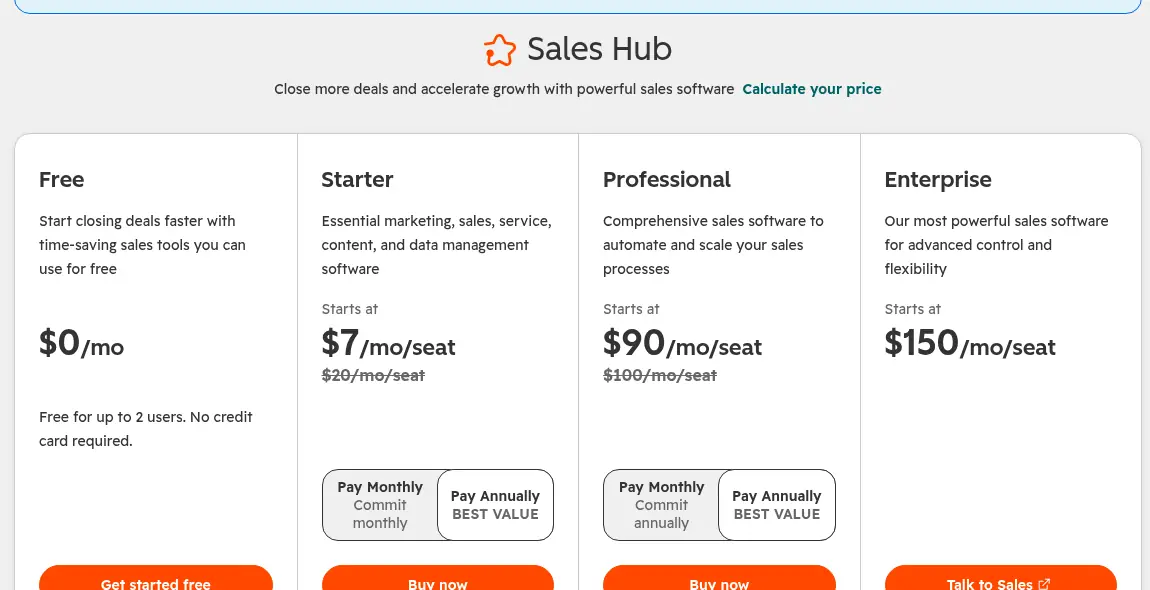
Source: HubSpot Sales Hub pricing page (USD), captured 2 Nov 2026
| Plan | Paid annually | Paid monthly | What you get |
|---|---|---|---|
| Free | $0 | $0 | Up to 2 users, 1,000 contacts, HubSpot branding |
| Starter | $7/seat/mo (new customers; list $20) | $10/seat/mo (new customers; list $20) | No branding, 500 credits, calling, simple automation, email and chat support |
| Sales Hub Professional | $90/seat/mo | $100/seat/mo (annual commitment) | Sequences, forecasting, deal plans, conversation intelligence, 3,000 credits; $1,500 one-time onboarding |
| Sales Hub Enterprise | $150/seat/mo | Not offered | Deal splits, approvals, sandbox, 5,000 credits; $3,500 one-time onboarding |
Prices checked on 2 Nov 2026 from hubspot.com/pricing/crm and hubspot.com/pricing/sales. Prices exclude tax.
Hidden costs to plan for
- Onboarding fees: Professional and Enterprise tiers carry a required one-time onboarding fee ($1,500 / $3,500 for Sales Hub; $3,000 / $7,000 for Marketing Hub).
- Marketing Hub is priced differently: Professional starts at $800/mo on annual billing ($890/mo monthly) with 3 core seats, and Enterprise starts at $3,600/mo with 5 core seats.
- The Starter discount is for new customers only and HubSpot describes it as a limited-time offer, so check the renewal price before you commit.
- Startups and nonprofits can apply for discounts through the HubSpot for Startups and HubSpot for Nonprofits programs.
HubSpot CRM Pros and Cons
Pros
- Free plan with no time limit and no credit card required.
- One contact timeline shared by marketing, sales, and service.
- Starter is cheap to try at $7/seat/mo on annual billing for new customers.
- Upgrades are modular: pay for the hub and tier you need, not the whole suite.
- Large knowledge base, HubSpot Academy courses, and community for self-help.
Cons
- Free plan is limited to 2 users and 1,000 contacts, far below older “unlimited” free offers.
- Free tools carry HubSpot branding on emails, chat, meetings links, and landing pages.
- Big price jump from Starter to Professional, plus required onboarding fees.
- Free users get community and knowledge-base help, not email or chat support.
- AI features use HubSpot Credits, which adds a usage-based cost to watch.
Also Read:
- HubSpot vs Salesforce: Which CRM Fits Your Team?
- Zoho vs HubSpot Comparison
- SharpSpring vs HubSpot
- Ontraport Review
HubSpot CRM Review FAQs
Is HubSpot CRM really free?
Yes. HubSpot's free tools include the CRM with no time limit and no credit card. The free account is limited to 2 users, 1,000 contacts, and 1,000 records across other standard objects, and free tools show HubSpot branding.
How much does HubSpot CRM cost after the free plan?
HubSpot Starter lists at $20 per seat per month. New customers can currently get $7 per seat per month with annual payment or $10 month to month. Sales Hub Professional is $90 per seat per month billed annually, and Enterprise is $150 per seat per month.
How many users can I add to HubSpot CRM for free?
HubSpot's free account allows up to 2 users. To add more people you need paid seats, starting with Starter.
Does HubSpot CRM charge onboarding fees?
Not on Free or Starter. Sales Hub Professional and Enterprise require one-time onboarding fees of $1,500 and $3,500, and Marketing Hub Professional and Enterprise require $3,000 and $7,000.
Does HubSpot CRM work with Gmail and Outlook?
Yes. HubSpot's free CRM tools connect to Gmail, Google Workspace, and many versions of Outlook, so emails can be logged and tracked on contact records.
Does HubSpot offer discounts for startups or nonprofits?
Yes. HubSpot offers discounted pricing to eligible companies through its HubSpot for Startups and HubSpot for Nonprofits programs; eligibility is checked when you apply.
Conclusion: HubSpot CRM Review 2026
HubSpot CRM is still a smart first CRM: it’s free to start, quick to set up, and keeps marketing, sales, and service activity on one record. Just go in with current expectations. The free plan now stops at 2 users and 1,000 contacts, so most growing teams will move to Starter, which is inexpensive while the new-customer discount applies.
The real decision comes later. If you need sequences, forecasting, or advanced automation, Professional costs $90 per seat per month plus a $1,500 onboarding fee, so price out a full year for your team before you commit. For a solo seller or small team, though, the free plan is the easiest way to test HubSpot with your own data.
