If you have products to sell online, Amazon and eBay are usually the first two marketplaces you look at. Both reach millions of buyers, but they charge differently, ship differently, and suit very different kinds of products.
Here’s the short answer to Amazon vs eBay: Amazon is usually the better fit for new, branded products you can restock, especially if you want Amazon to store and ship them through FBA. eBay is usually better for used, refurbished, collectible and one-off items, and it’s cheaper to start because you get up to 250 listings a month with no insertion fee. Below, I compare the current fees (checked on both official sites on 20 Oct 2026), fulfillment, buyer protection and selling formats so you can pick the right one, or use both.
Pre-Verdict: Amazon or eBay?
Pick Amazon if you sell new items in volume, want Prime-eligible fast shipping without running a warehouse, and are happy to compete on price within Amazon’s product pages.
Pick eBay if you sell secondhand goods, collectibles, parts or unique items, want to run auctions, or want to test the waters with almost no upfront cost.
Use both if you have new stock that sells well on Amazon and older, open-box or returned units that sell better on eBay. Just keep inventory in sync so you don’t sell the same unit twice.
What Is Selling on Amazon?
Amazon lets third-party sellers list products in its store alongside Amazon’s own retail listings. You choose one of two selling plans: Individual, which costs $0.99 per item sold, or Professional, which costs $39.99 per month. Amazon says you can switch or cancel your plan at any time after registration.
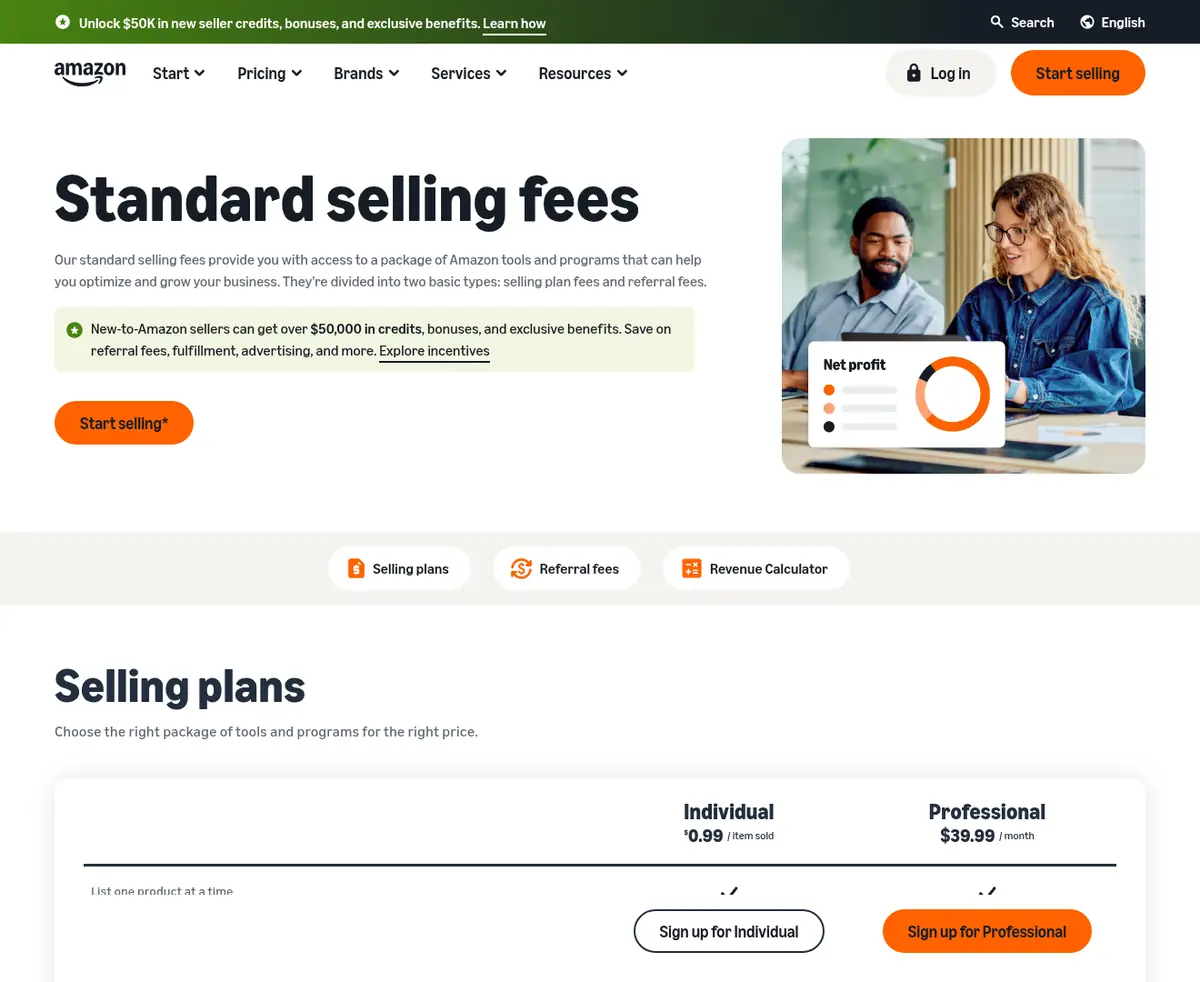
Source: Amazon standard selling fees page, captured 20 Oct 2026
Both plans let you list products one at a time, set prices, and use either Fulfillment by Amazon (FBA) or ship orders yourself (Fulfilled by Merchant). The Professional plan adds bulk listing tools, Amazon Ads, brand-building tools, automated pricing, B2B selling through Amazon Business, Global Selling and API access. If you sell more than 40 items a month, the Professional plan costs less than paying $0.99 per item.
On top of the plan fee, Amazon charges a referral fee on every sale, calculated on the total price including shipping and gift wrap. Most categories are 15% with a $0.30 minimum, such as Home and Kitchen, Toys and Games, Sports and Outdoors, Office Products and Tools. Some are lower, such as 8% for Computers and Consumer Electronics, while Clothing ranges from 5% to 17% depending on price. Media items (books, DVDs, music, software and video) also carry a $1.80 closing fee per item.
If you’re just getting started, read our guide to starting your own Amazon business before you pick a plan.
What Is Selling on eBay?
eBay is a marketplace where sellers create their own listings, either as auction-style listings that buyers bid on or as fixed price (Buy It Now) listings, which can run as Good ‘Til Cancelled and renew automatically. There is no monthly fee unless you open an eBay Store.
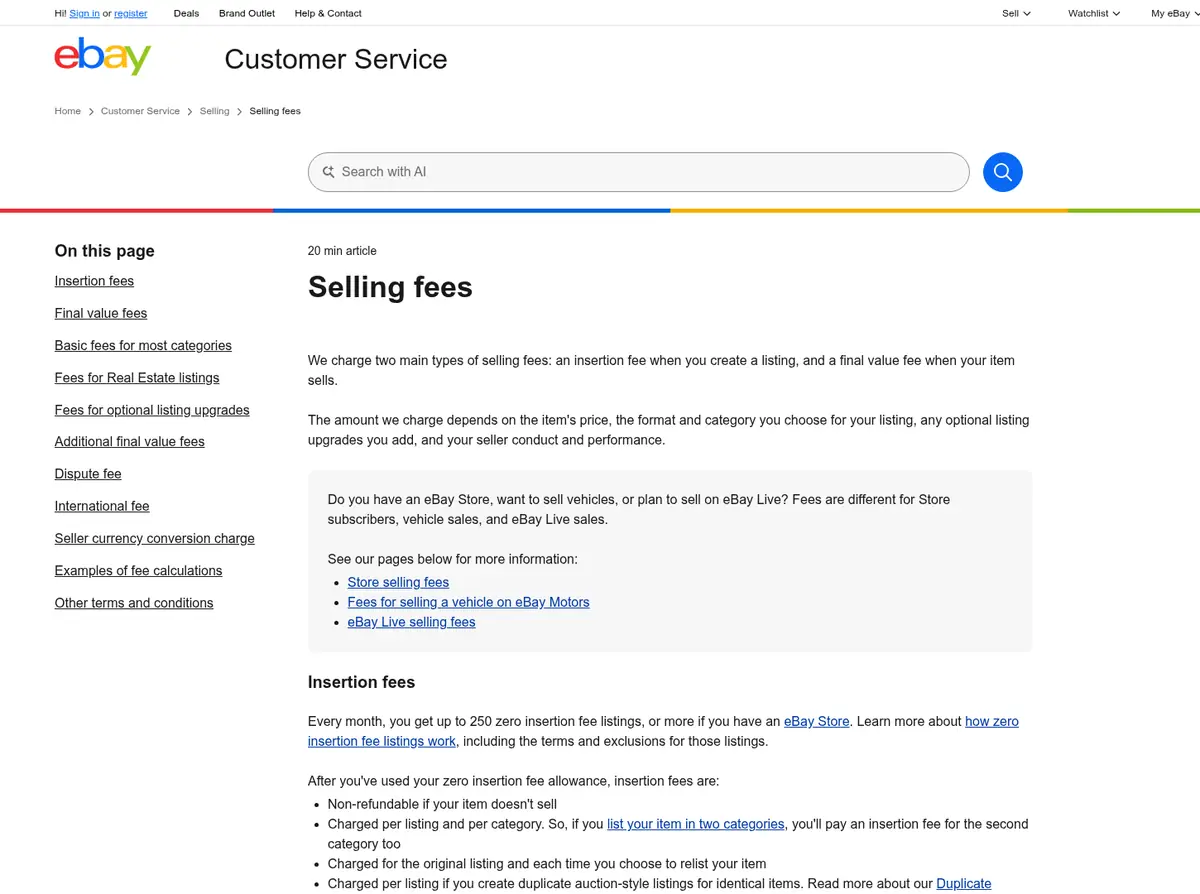
Source: eBay selling fees help page, captured 20 Oct 2026
eBay charges two main fees. The first is an insertion fee when you create a listing, but every account gets up to 250 zero insertion fee listings a month (more with an eBay Store); after that it’s $0.35 per listing in most categories. The second is a final value fee when the item sells: 13.6% of the total amount of the sale up to $7,500 in most categories, plus a per-order fee of $0.40 (or $0.30 for orders of $10 or less). eBay says there are no separate third-party payment processing fees on top of that.
The “total amount of the sale” on eBay includes the item price, shipping, handling and sales tax, so your fee is a little higher than the sticker price suggests. Some categories differ, for example 15.3% for Books, Movies and Music, 6.7% for Guitars and Basses, and 8% with no per-order fee for athletic shoes selling for $150 or more.
Want more visibility once you’re listed? Our guide on how to advertise on eBay covers promoted listings and other options.
Amazon vs eBay: Differences and Similarities
| Feature | Amazon | eBay |
|---|---|---|
| Account cost | Individual $0.99 per item sold, or Professional $39.99/month | No monthly fee; optional eBay Store subscription |
| Listing fee | None | 250 free listings/month, then $0.35 each (most categories) |
| Sale fee (most categories) | Referral fee, usually 15% (min $0.30) | 13.6% final value fee + $0.40 per order ($0.30 if $10 or less) |
| Selling formats | Fixed price only | Auction-style or fixed price (Buy It Now) |
| Fulfillment | Ship yourself or use FBA (Amazon stores, packs, ships and handles returns) | Ship yourself or use a third-party fulfillment company |
| Prime eligibility | Yes, through FBA | No Prime equivalent |
| Buyer protection | A-to-z Guarantee on third-party orders | eBay Money Back Guarantee on most transactions |
| Best for | New, branded, repeatable products | Used, refurbished, collectible and one-off items |
Fees checked on 20 Oct 2026 on sell.amazon.com/pricing and eBay’s selling fees help page (US).
Fulfillment: FBA is Amazon’s biggest advantage
With FBA, you send stock to Amazon’s fulfillment centers and Amazon picks, packs and ships each order, handles customer service and returns, and makes your products eligible for free two-day Prime shipping. FBA fees depend on size, weight and storage time, so check them in Amazon’s revenue calculator before you commit. New Professional sellers also get FBA incentives such as $100 off inbound shipments through the Amazon Partnered Carrier program, a $400 credit for inbound placement costs, and free storage and returns through the FBA New Selection program.
eBay doesn’t run warehouses for US sellers the way Amazon does. You store, pack and ship orders yourself or pay a third-party logistics (3PL) company to do it. That’s more work, but it also means no storage fees and full control over packaging.
Buyer protection and returns
Amazon’s A-to-z Guarantee protects shoppers who buy from third-party sellers that ship their own orders. Buyers can claim if an order is late, damaged or not as described, or if a seller doesn’t handle a return, as long as the last possible delivery date was within 90 days.
eBay’s Money Back Guarantee covers most purchases paid through eBay checkout. Buyers get their money back if an item doesn’t arrive, is faulty or damaged, or doesn’t match the listing. eBay sellers set their own return policy for change-of-mind returns, but they still have to resolve not-received and not-as-described cases. On both marketplaces, poor service hurts you: eBay, for example, adds 6% to final value fees for accounts rated Below Standard.
Pricing control: auctions vs fixed price
Amazon is fixed-price only, and several sellers often share the same product page, so you compete on price, delivery speed and seller rating. eBay gives you your own listing page and lets you choose between auctions, which can push prices up on rare or in-demand items, and fixed-price listings. You can also add a reserve price on eBay auctions, which costs $5 or 7.5% of the reserve (whichever is greater, up to $250), whether or not the item sells.
Product condition and type
Amazon’s shoppers mostly expect new products with consistent listings, which suits brands, private-label products and wholesale stock. eBay is built for variety: used electronics, vintage clothing, car parts, trading cards and collectibles are all core categories, and eBay even has dedicated fee rates for things like coins, trading cards and watches.
Pricing Plans: Amazon vs eBay Fees on a $40 Sale
Here’s a simple example for a $40 item (shipping included) in a standard category, before shipping costs, sales tax and any optional upgrades:
| Fee | Amazon (Individual) | Amazon (Professional) | eBay |
|---|---|---|---|
| Plan or subscription | $0.99 per item | $39.99/month (spread across all sales) | $0 (no Store) |
| Listing fee | $0 | $0 | $0 within 250 free listings |
| Sale fee | 15% referral = $6.00 | 15% referral = $6.00 | 13.6% = $5.44 + $0.40 = $5.84 |
| Total per sale | $6.99 | $6.00 + share of $39.99 | $5.84 |
Example based on fees listed on 20 Oct 2026. FBA fees (Amazon) and shipping labels (both) are extra; eBay calculates its fee on a total that includes sales tax.
On a single sale, eBay is slightly cheaper. The gap closes or flips once you factor in FBA, which replaces your own packing and shipping costs, and Amazon’s new-seller incentives, which include referral-fee waivers for new-to-Amazon brands in their first year. eBay also charges extra for some choices: a 1.65% international fee if you ship abroad without eBay International Shipping, optional listing upgrades such as bold titles or subtitles, and a $20 fee for each payment dispute you’re found responsible for.
If you go the Amazon route, the right tools make a big difference. See our list of the best Amazon seller tools and our Helium 10 vs Jungle Scout comparison for product research.
Amazon vs eBay FAQs
Is it cheaper to sell on Amazon or eBay?
On a single sale in a standard category, eBay is usually slightly cheaper: 13.6% plus $0.40 per order, with 250 free listings a month. Amazon charges a referral fee of about 15% in most categories plus either $0.99 per item (Individual) or $39.99 a month (Professional). FBA fees, shipping and new-seller credits can change the result, so run your own numbers.
Does Amazon charge a monthly fee to sell?
Only on the Professional plan, which costs $39.99 a month. The Individual plan has no monthly fee but charges $0.99 for every item sold, and Amazon lets you switch or cancel your plan at any time.
How many free listings do you get on eBay?
eBay gives every seller up to 250 zero insertion fee listings a month, and more if you subscribe to an eBay Store. After that, most categories cost $0.35 per listing, and the fee is charged again each time a listing is relisted.
Does eBay have anything like Amazon FBA?
Not in the US. eBay doesn't store or ship inventory for sellers the way Amazon FBA does, so eBay sellers ship orders themselves or hire a third-party fulfillment company.
Which protects buyers better, Amazon or eBay?
Both have strong buyer protection. Amazon's A-to-z Guarantee covers third-party orders within 90 days of the last delivery date, and eBay's Money Back Guarantee covers items that don't arrive, are damaged or don't match the listing when paid through eBay checkout.
Can I sell the same products on Amazon and eBay?
Yes. Many sellers list new stock on Amazon and used, open-box or older stock on eBay. If you list the same units on both, use inventory sync so a sale on one marketplace removes the item from the other.
Final Thoughts: Amazon vs eBay 2026
For most sellers with new products they can restock, Amazon is the better choice. FBA and Prime give you fast shipping and customer service without running a warehouse, and the Professional plan unlocks the tools you need to grow. For used goods, collectibles and one-off items, or if you want to start with almost no upfront cost, eBay is the better choice thanks to auctions, flexible listings and 250 free listings a month.
You don’t have to choose forever. Start where your products fit best, track your fees per sale, and add the second marketplace once your first one is running smoothly.
